Reflect & Rise: 15-Min Self-Reflection Routine + AI
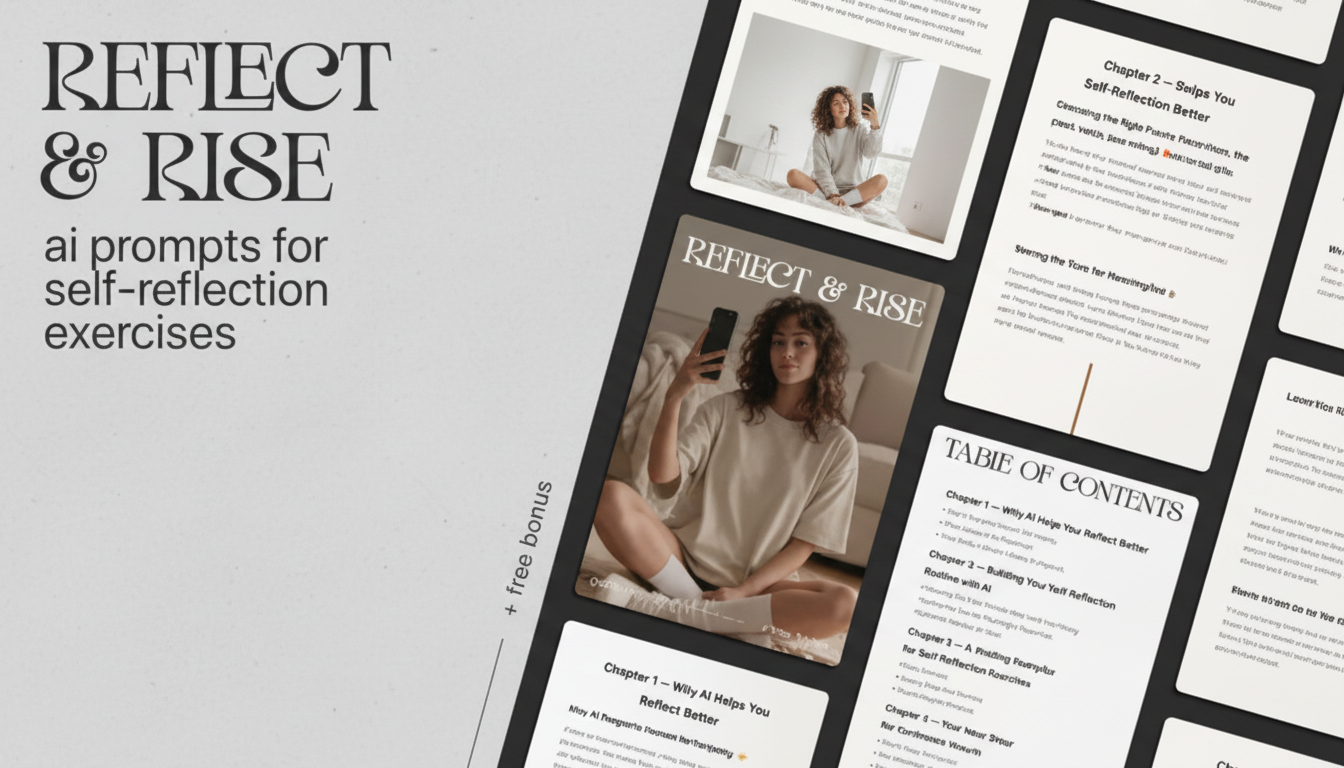
Reflect & Rise: A Practical Self-Reflection Routine You Can Do in 15 Minutes
Self-reflection works best when it is simple, repeatable, and tied to next steps. Reflect & Rise is a digital self-reflection guide that combines structured journal pages, a printable checklist, and AI-supported exercises to help turn scattered thoughts into clear patterns and small, realistic actions. This guide fits into a daily or weekly rhythm—especially for anyone who wants more emotional clarity, better decisions, and steady mindset growth without overcomplicating the process.
If you prefer a clear structure (instead of a blank page), Reflect & Rise — Self-Reflection Guide with AI (digital download) is designed to make reflection feel doable on busy days and still meaningful on slower ones.
What “Reflect & Rise” Helps You Do (Without Overthinking It)
- Move from vague feelings to specific insights by using guided questions and quick rating scales.
- Spot repeating patterns: triggers, habits, self-talk, energy drains, and what reliably restores motivation.
- Turn reflection into action through small commitments that are easy to follow through on.
- Use AI as a supportive tool for reframing, idea generation, and perspective checks—without replacing personal judgment.
- Build consistency with an optional printable checklist for daily/weekly review.
In simple terms, self-reflection is the practice of examining your own thoughts, feelings, and actions. The American Psychological Association describes self-reflection as a form of introspection that helps people better understand themselves and their experiences (APA Dictionary of Psychology).
What’s Included in the Digital Download
- eBook-style guide with a structured reflection flow: check-in, clarify, reframe, decide, and commit.
- Mindset growth journal question sets designed to uncover values, priorities, and limiting beliefs.
- Printable checklist for building a routine that sticks (daily, weekly, and monthly options).
- AI-supported reflection question sets for reframing thoughts, exploring alternatives, and creating next-step plans.
- Instant access as a digital download—print selected pages or use digitally depending on preference.
Format at a Glance
| Component | Best for | How to use it |
|---|---|---|
| Guided reflection pages | Clarity and emotional processing | Answer in 5–10 minutes; highlight one key insight |
| Journal question sets | Mindset growth and self-awareness | Choose 1 question set per session; write freely for 3–7 minutes |
| Printable checklist | Consistency and accountability | Check off the routine; review streaks weekly |
| AI reflection question sets | Reframing and action ideas | Ask for 3 options; select one that matches personal values |
A 15-Minute Daily Routine (The Reflect → Rise Loop)
This is the routine the guide is built to support. It’s intentionally short: long enough to be honest, short enough to repeat.
- Minute 1–3: Quick check-in. Rate mood, energy, and stress. Name the dominant emotion without judging it.
- Minute 4–7: What happened? Capture one key event or thought loop from the last 24 hours.
- Minute 8–11: Meaning and pattern. Identify a trigger, belief, or unmet need (rest, respect, control, connection).
- Minute 12–14: Reframe. Write a more balanced statement (true, kind, and useful). Optional: use AI to generate alternative viewpoints, then keep only what feels aligned.
- Minute 15: One next step. Choose a single action (2 minutes to 20 minutes) to complete today.
The reframe step pairs well with the general principles used in cognitive behavioral therapy (CBT), which focuses on noticing unhelpful thought patterns and building more balanced thinking (American Psychological Association: CBT overview).
Using AI Without Losing Your Own Voice
- Use AI for expansion, not authority. Treat responses as brainstorming that must pass a “does this fit me?” test.
- Helpful AI requests: generate gentle reframes, list options, suggest follow-up questions to ask yourself, or summarize what you wrote into a few themes.
- Avoid outsourcing core decisions. Values, boundaries, and relationships require personal context and accountability.
- Privacy note: avoid entering sensitive identifiers; keep entries general if using an online tool.
When used this way, AI becomes more like a mirror than a manager: it can offer angles you didn’t consider, but you decide what’s true and what’s next.
When to Use Which Question Sets
- If stuck in self-criticism: use questions that separate behavior from identity and focus on learning.
- If feeling unmotivated: use questions that reconnect actions to values, meaning, and realistic rewards.
- If anxious or overwhelmed: use questions that narrow focus to what is controllable today.
- If repeating the same problem: use questions that explore patterns, triggers, and boundaries.
- If making a decision: use questions that clarify trade-offs, minimum requirements, and the “next right step.”
Make the Checklist Work: Consistency Over Intensity
If consistency is the goal, it helps to think like a habit builder: make it obvious, make it easy, and make it satisfying. Practical behavior-change advice like James Clear’s habit framework can be a useful reference point for building the routine into real life (James Clear: Habits and behavior change).
Who This Guide Fits Best
For a focused companion tool when your reflection turns into “What should I charge?” or “How do I structure my rates?”, Rate Right | Freelance Pricing Checklist with AI can help translate your insights into a practical pricing decision—without turning it into a drawn-out spreadsheet project.
FAQ
Can this be used digitally, or does it need to be printed?
It’s a digital download, so you can use it on a tablet or computer, or print only the pages you want for a binder. Many people mix both—digital for daily check-ins and printed pages for weekly reviews.
Do the AI exercises require a specific tool or subscription?
No. The AI portion is based on question sets you can use with common AI chat tools, and the core guide is fully useful even without any AI at all.
How often should the reflection routine be done to see results?
A realistic baseline is 3–5 short sessions per week plus a weekly review to spot patterns and pick one small focus for the next week. Consistency and follow-through on tiny actions matter more than long sessions.















Leave a comment